The Brigade consisted of the 10th, 18th,
19th and 20th Virginia Battalions of artillery, the Chaffin's Bluff garrison composed of five unattached Virginia companies
of artillery, temporarily organized as a battalion, and the 18th Georgia battalion.
These battalions were organized in pairs,
and commanded as follows: the Chaffin's Bluff battalion and the 18th Georgia by Major W. H. Gibbes; the 18th and 19th Virginia
by Lieutenant-Colonel Howard; the 10th and 20th Virginia by Lieutenant-Colonel Atkinson.
I need not recapitulate the circumstances
of the march; nor enlarge on the starving condition of the troops, further than to say that from the commencement of the movement
to the moment of our falling into the hands of the enemy, the only stores issued were, one pound of meal and one-third of
a pound of bacon. these were issued on the afternoon of the 4th, and so far as I was informed, only to this brigade; the Brigade
Commissary having, fortunately, that small supply on hand.
We saw or heard no signs of the enemy until
the 5th, when reports of small arms at some distance indicated their approach. Having passed Amelia Court House several miles,
several companies, from the Chaffin's Bluff Battalion, and from the battalion under Colonel Atkinson's command, were deployed
as skirmishers on the left of the line of march, and continued to march in that order and position, parallel to the column,
during all that day and night. But there was no appearance of an enemy until about 10 o'clock that night, when we were fired
upon by what was supposed to be a small advanced party of the enemy's cavalry.
About 10 or 11 o'clock on the morning of
the 6th the enemy being discovered in close proximity, the brigade was formed in line of battle faced to the left. I presumed
to cover the passage of the trains. But the enemy contented himself with shelling the trains and the road by which the troops
passed. But no one was hurt.
After crossing Sailor's Creek, and while
halted near the crest of the hill beyond it, the enemy was discovered advancing in heavy force towards our left and rear.
His artillery came up rapidly and took position on the summit of the hill we had recently passed over, on the other side of
the creek, near the houses of Hillsmans' farm., and not more than 350 and 400 yards from us, as I have ascertained by a subsequent
careful examination of the ground.
The division immediately formed line, facing
to the rear, about one-third of the distance down the hill, Crutchfield's Brigade on the right. But before the line was formed,
and while the greater part of the troops were yet moving to their position, the enemy opened fire with case, shells, and canister.
The 18th Georgia was on the extreme right
of the brigade; next stood the Chaffin's Bluff troops, Major Robert Stiles. In consequence of the transfer of Major Gibbes
on the day previous, to Hardaway's Battalion of Artillery, the command of these two battalion had devolved on myself. The
conformation of the ground was such that I could see distinctly only these two battalions after getting into position. Consequently,
whatever I have to state further relates to them alone.
The different battalions moved up successively
from right to left. No sooner were the colors of the 18th Georgia and Chaffin's Bluff troops established, than the enemy directed
his fire upon those commands with great rapidity and accuracy. But both battalions dressed up to their colors with as much
steadiness and formality as if on parade. I observed particularly the Chaffin's Bluff companies, as I was told they had never
before been engaged. There was something surprising in their perfect steadiness and order. By this time many casualties having
occurred, and the enemy's fire becoming remarkably accurate and severe, the troops were directed to lie down in their places.
But notwithstanding this precaution, many of Major Stiles' command were killed and wounded. The 18th Georgia suffered not
at all, as they lay in a slight depression of the ground. I do not think I had a man hurt by artillery during the engagement.
Covered by his artillery the enemy moved
up his infantry in three lines of battle, preceded by skirmishers. As soon as our own skirmishers had retired, they were received
with a general discharge from our whole line, which speedily threw their first line into confusion, killing and wounding considerable
numbers.
Unable to face our fire, that line fell
back in disorder, which, as I was afterwards told, they communicated to their second line. Such was the eagerness of Major
Stiles' men, that upon perceiving the enemy's hesitation, they sprang up from their recumbent attitude and rushed upon them,
fixing bayonets as they advanced; and it was with difficulty that Major Stiles and I could check them and restore the line.
I was also afterwards informed, by other officers of the brigade that the enemy's second line was broken in a similar manner
by our fire, and that his third line was met by ours in a general advance with the bayonet, and driven back beyond the creek,
when the flag of truce appeared announcing the surrender of the whole corps by General Ewell.
I communicate information received from
others of what did not fall under my own observation, for the sake of the corroboration it may give to statements from other
quarters. After the restoration of our line, broken, as just state, by the precipitate charge of Major Stiles' command, my
attention was confined to what took place on our extreme right, and I saw no more of the general engagement. [ missing text]
adequate to praise them as they deserve. But while I have an opportunity to speak, the living must not lose, through my silence,
their claim to the gratitude of their country, nor the dead that honorable mention which belongs to the soldier who falls
in a righteous cause.
I have before stated that my battalion
was on the extreme right of the brigade. Its right rested on the road by which we had marched after crossing the creek. On
the other side of the road was a dense pine thicket, which concealed all beyond from view. Perhaps you will recollect passing
the command early in the engagement, and telling me I might feel secure about my flank, as Kershaw's Division was beyond the
thicket; as I understood matters, with his extreme left covering our flank, his line being at right angles to ours.
After re-establishing Major Stiles' Battalion,
I passed up to our right. I had scarcely got there, when I perceived a large body of the enemy advancing through the thicket
diagonally upon our flank, and already with in about forty yards. They could not have been seen at a greater distance, so
close were the trees. I had but eighty-five men, but I could not leave the spot, nor was there a moment to spare. I changed
front instantly (receiving, as the movement was made, a volley which proved fatal to several), and took position in a wide
and shallow gully at the road-side. Perceiving that the superior numbers of the enemy would enable him to destroy us by his
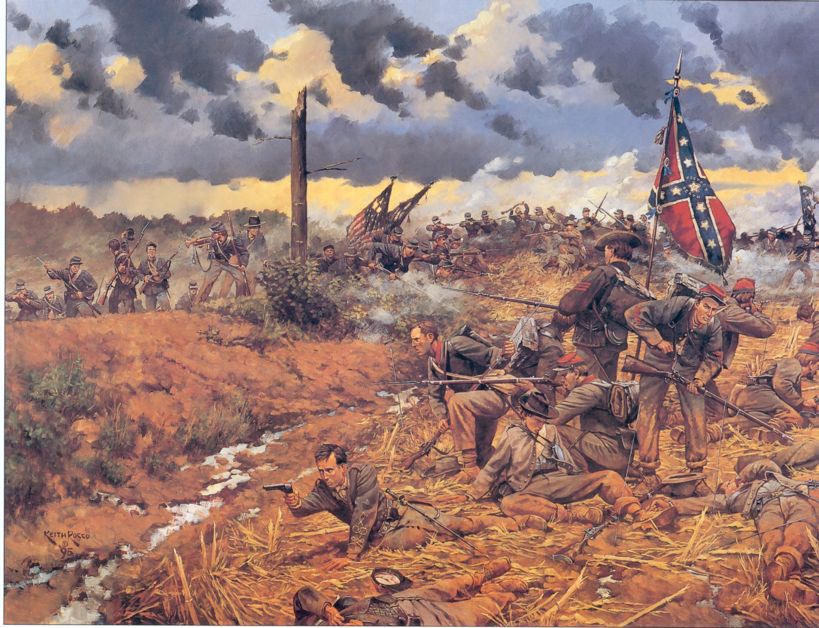
fire, I ordered bayonets fixed and attacked.
Through the extraordinary gallantry of
the men, the attack was entirely successful. Many of the enemy were killed with the bayonet, and the rest were driven off
in disorder, after a desperate struggle, distinguished by many acts of individual heroism. Lieutenant G. M. Turner, though
previously wounded on the skirmish line, joined in the charge, and was shot down in the act of saving the life of a comrade.
Lieutenant W. D. Grant took a regimental flag from the hands of its bearer, and was prostrated by mortal wounds immediately
after delivering it to me. Sergeant George James is reported to have taken another, and fell shortly after. Captain G. C.
Rice was over powered by an officer of the enemy of greatly superior size and strength, in Confederate uniform, and was shot
by him on the ground, after he had surrendered. Lieutenant W. H. King revenged him and was himself killed on the instant.
Sergeant C. B. Postal, [ missing text ] F. Tupper, pursuing too far, fell mortally wounded on the bank of the creek, about
300 yards from our position.
I hope I did not commit an error in taking
this course. The safety of the brigade was at stake. If my brave fellows had flinched or given way, the enemy would have thrown
himself on our flank, and the general loss must have been much greater than it was.
I had scarcely reassembled the remnant
of the battalion in its original position, with but one officer unwounded besides myself, when you passed by and reassured
me as to my apprehensions of further molestation from that quarter by the information that other troops had been sent to guard
that approach. They probably never reached their destination; for in a very few minutes another but smaller body of the enemy
came on over the same ground. Supposing them to be some of our own troops giving way, I took my men out to rally them and
discovered that they were enemies only when within a few paces. I attempted, as our only recourse, to repeat the attack which
has just terminated so well; but over powered by superior numbers, though fighting to the last, all the rest of the command
were killed, wounded or taken. Sergeants R. Millen and S. Morton stood to the last before their colors, keeping at bay a party
of about fifty men, and were the last to fall.
Seeing then but one officer and the non-commissioned
staff remaining, I displayed my handkerchief in token of surrender. As I did so, the enemy, hitherto sheltering themselves
behind the trees, rushed into the road, and fired upon my wounded who lay in the gully before mentioned. It was with the greatest
difficulty they could be induced to cease from this barbarity I mention this closing incident as one more of the numerous
atrocities which indicated the relentless spirit in which the war was waged against us.
The loss in the 18th Georgia Battalion
was thirty killed, including those who subsequently died of their wounds, and twenty-two wounded; in all sixty-one per cent.
of the number engaged.
Major Stiles conjectured the loss in his
command to have been about 100 killed and wounded. I do not know of any attempt to estimate the loss in the rest of the brigade.
Having subsequently re-visited the field
and passed some days in its immediate vicinity, I was informed by one of the neighboring residents that the troops encountered
by my battalion were Hamblin's Brigade of the 6th Corps, consisting of three regiments, of which one-half were ordered forward
at each time.
The information was obtained from General
Hamblin himself, who further admitted that he suffered very severely and lost six colors. As I heard of but two regimental
flags, I presume the others were markers' flags. Indeed, one of my men told me that he saw Lieutenant King, whose death is
above-mentioned, with tow markers' flags shortly before he fell. It seems scarcely possible that this battalion could have
contended successfully with even a single regiment unless reduced to its own feeble dimensions. It can be explained, however,
by the fact that they were thrown into some disorder by the closeness of the thicket through which they advanced, and being
thus caught in detail by a sudden attack had no opportunity to recover themselves.
I have thus, General, given an account,
perhaps too detailed, of the fortunes of the brigade from the evacuation to its capture, in what fell under my own observation.
If anything is omitted which was stated in my former communication in unofficial form, I beg you will make the necessary correction
and additions. I have been more minute than would have been necessary or, perhaps, even proper, under other circumstances.
But I feel with our that since they have lost all else, we ought to save for our brave soldiers all the honors they so hardly
won. All their toils and sufferings and dangers have been apparently in vain; but they fought in a just cause, and if they
did not achieve success they at least deserved it. I await with impatience the day when the world will do justice to our countrymen.
I have the honor to remain, General,
Very respectfully, your obedient servant,
WM.
S. BASINGER,
Major, Com'd'g 18th Georgia Battalion.